
Seeing ag through another’s eyes.
By Harlen Persinger, ACN Member
My initial meeting with Masaru Yamada occurred in 2006 during the International Federated Agricultural Journalists (IFAJ) Congress in Norway. Since then, we have continued to build that relationship during this annual event while visiting many other countries. As a freelance writer who has generated stories on various topics covering world agriculture, Masaru often queried me about visiting my home farm in Iowa.
Last fall, when the talk of world tariffs became international news, he decided it was an ideal time to come to America’s heartland and gather information for a Japanese publication.
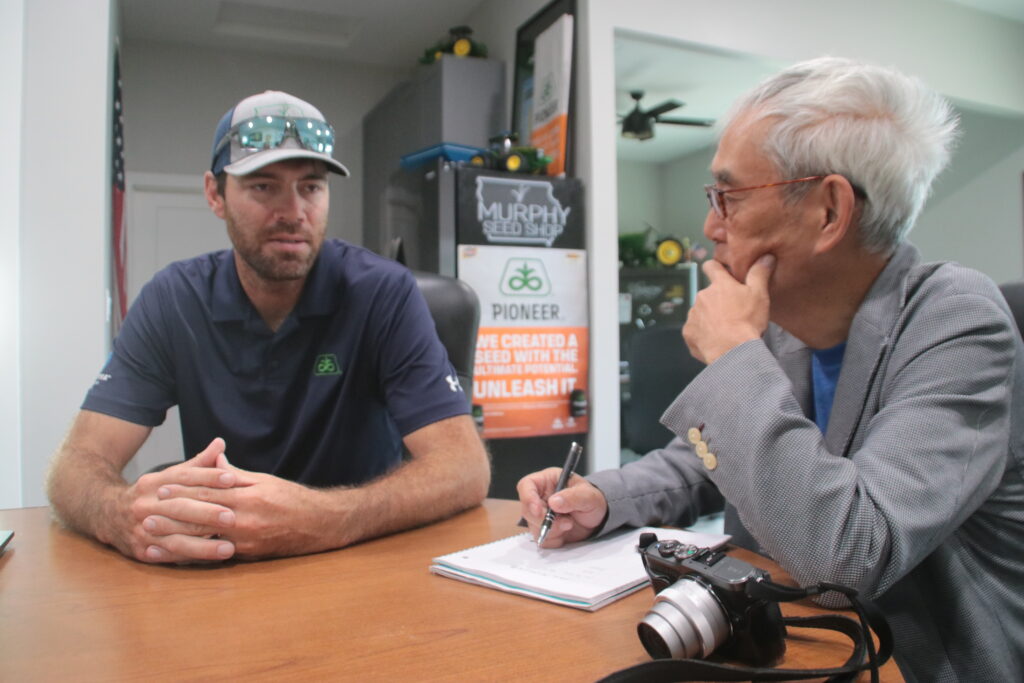
However, he needed a local contact to help set up interviews and take photos for Toyo Keizai, a version of Businessweek. So in September, we spent a week talking with 13 individuals from commodity groups, local farmers, equipment dealers, various media outlets and some agriculture professors at Iowa State University about current farm policies.
“My primary mission was to learn how American Midwestern farmers were confronting a situation where China had imposed high tariffs against them and their crops, mainly soybeans. I wanted to know what the rural community thought of President Trump and how farmers try to mitigate the damage in the long run,” Masaru says. “What measures were they taking to deal with high production costs and land values versus lower commodity prices? Other topics that piqued my interest were about water quality concerns, cover crops, buffers, filter grass strips and conservation tillage.”
“I learned that farmers are supportive of President Trump, much more than I expected. There are similarities between U.S. and Japanese farmers, concerning soil saving practices, family heritage and a focus on agriculture,” he adds. “I observed cultural differences. Not many of the younger generation in Japan enter the business sector of agriculture. The mindset of Japanese people focus on their traditions and culture versus U.S. farmers who spend more time on building their enterprise. Of course, raising rice is much different than growing continuous corn and the soybean crops. My take is that the population is much older in Japan, with health being a priority in that generation.”
Personal Thoughts
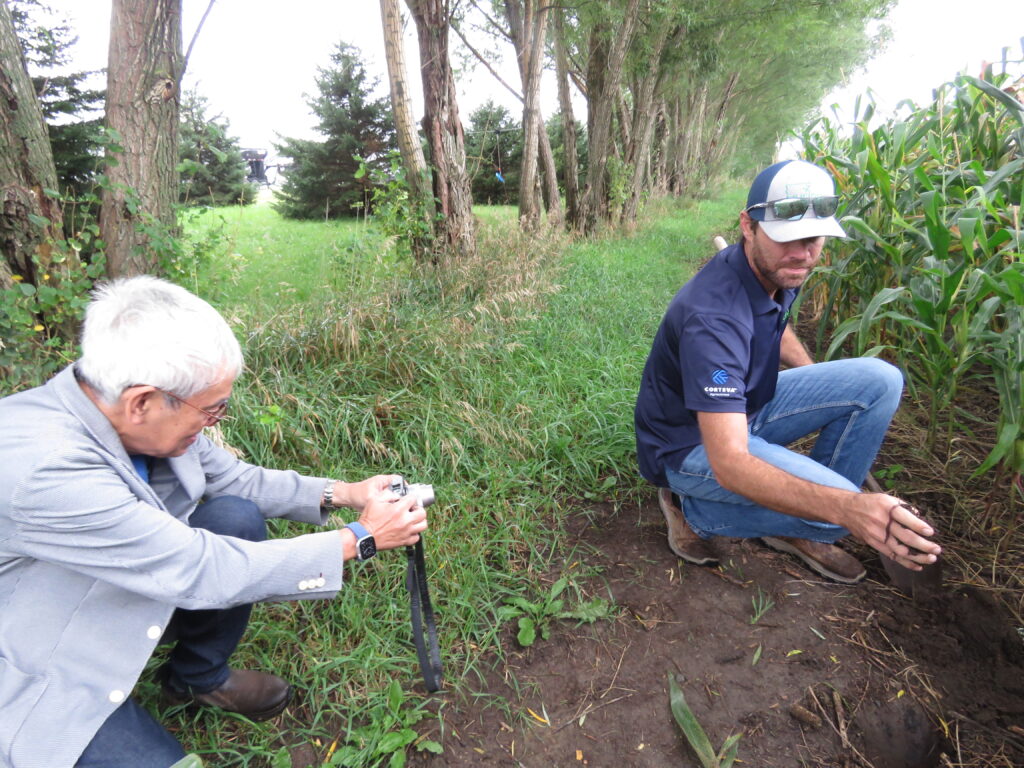
He settled into an interview with Brian Feldpausch, a family farmer in Grundy County. Feldpausch mentioned that high-performance seeds, adding trace elements like sulfur and installing drainage tiles in the fields have helped boost overall crop yields. His main concern about receiving more income on the bottom line was a depressed soybean market, primarily due to tariffs ramping up a trade conflict with China.
Feldspausch noted state-of-the-art tractors come with all sorts of features, but buying the same horsepower now costs twice what it did five years ago. Ammonia (nitrogen fertilizer) skyrocketed in 2022 due to the Russia-Ukraine war. It dropped somewhat since but hasn’t returned to previous prices. Everything is getting more expensive because of inflation. It’s a daily problem.
In 2026, he will slash costs drastically. While he has always spread fertilizer evenly to improve soil fertility, amounts will be limited to the bare minimum. His strategy is to curb cash outflows for now and wait for the storm overhead to pass.
In the 2024 presidential election, voters in Grundy County cast 4,998 votes for Trump – more than 70% of the total turnout. Feldspausch, a vice president of the Iowa Farm Bureau Federation, believes Trump will bring something to the table in the long run. He is also responding to farmers’ requests, such as tax cuts, reduced inheritance tax and deregulation.
Grant Kimberely, director of market development for the Iowa Soybean Association, hopes the U.S. and China will reach an agreement and that soybean exports to China will begin as soon as possible. He notes that a key to an agreement is to incorporate a mechanism for China to keep its promises. During Trump’s first term, China promised to import large amounts of U.S. ag products, but the spread of COVID-19 and other factors left that deal unresolved.
Dealing With Tariffs
Chad Hart, professor of ag economics at Iowa State University, deals primarily with world tariff policy. He notes that the biggest challenge facing American agriculture stems from its high productivity. It supplies more ag products than demand requires, so when demand slows anywhere, prices fall. This time, China’s import of soybeans was that trigger.
There is a precedent for Trump supporting farmers during the U.S.-China trade war that erupted during his first term. However, Congress approved $30 billion in subsidies specifically for COVID-19 and weather disaster relief after Trump lost the presidential election to Biden. Farmers are conservative and traditionally support the Republican Party; it’s natural for them to favor Trump, who has pushed conservative judges onto the Supreme Court and advocates for smaller government. They also appreciate his tax cuts and deregulation. When they face short-term difficulties due to trade friction with China, farmers are likely to highly value Trump’s ability to extract concessions from foreign countries through trade concessions.
Special Memories
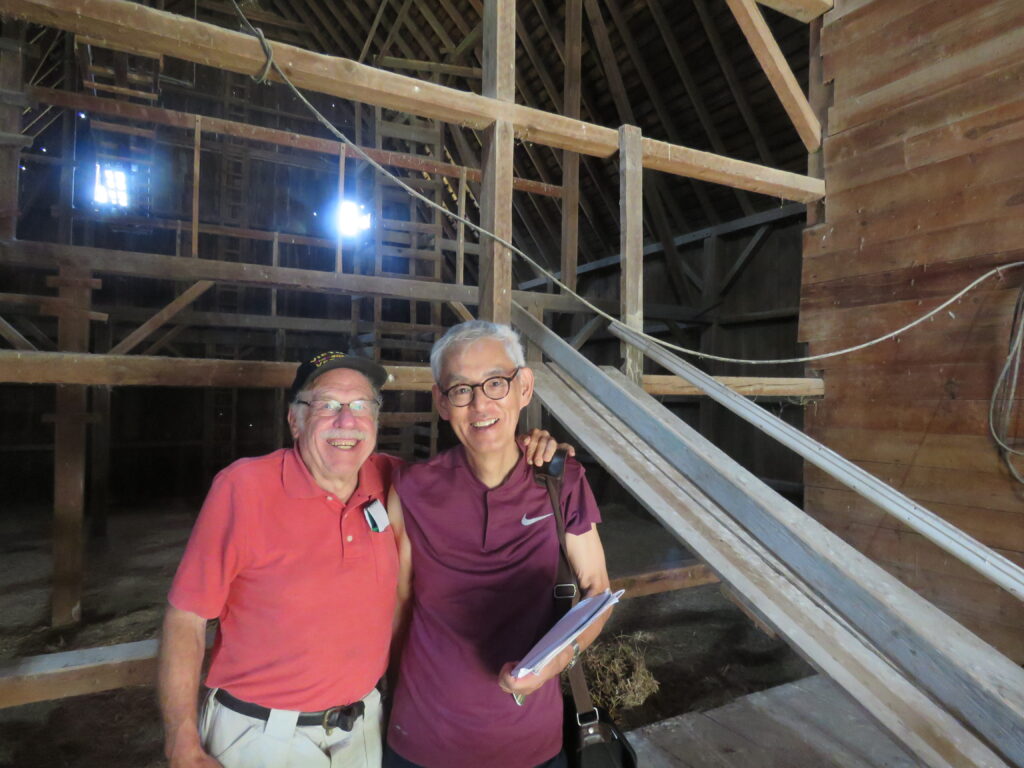
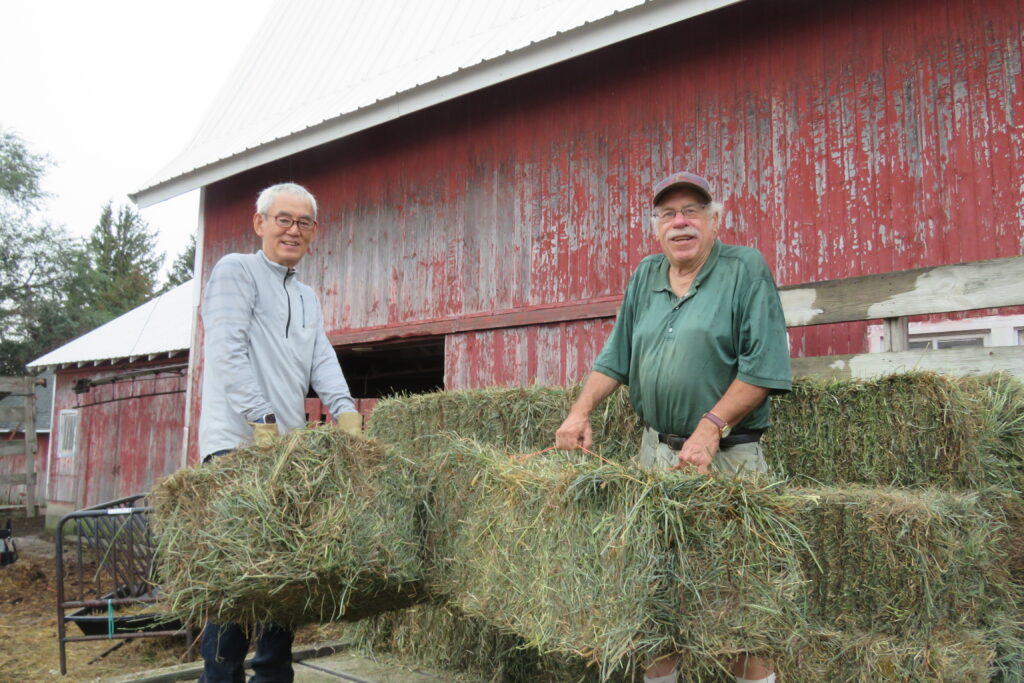
After spending time gathering interviews, social activities were also on the agenda in farm country. We went on a vintage barn tour, connected with the local historical society, photographed the corn harvest at the AG 450 Iowa State University research farm, made sure to munch on some fresh sweet corn (which costs $3/ear in Japan) and prepared a sushi meal at a friend’s home. However, the most unexpected venture was mowing, baling, loading and storing the late-season alfalfa hay crop in the century-old red barn just before a rain shower passed by.
As I drove the four hours back to Chicago for my flight home, browned fields of corn and soybeans from a frost were endlessly altered across the landscape. Large combines chugged along and grain carts methodically took in the bountiful crop. This is the Corn Belt, blessed with rich, black soil and flat terrain, which forms the backbone of America.
“For a few days, I welcomed the opportunity to see this part of the U.S. through a different perspective. Making that acquaintance and cultivating a special friendship with Harlen over the past 20 years has certainly paid dividends,” Masaru concludes. “He is well connected to the land, respected in his community, and I truly felt fortunate for the opportunity to visit his home farm.”
– Persinger operates H Lens Photography and freelance writing, served on the ACN Board of Directors and is a multiple award-winning photographer and writer.