
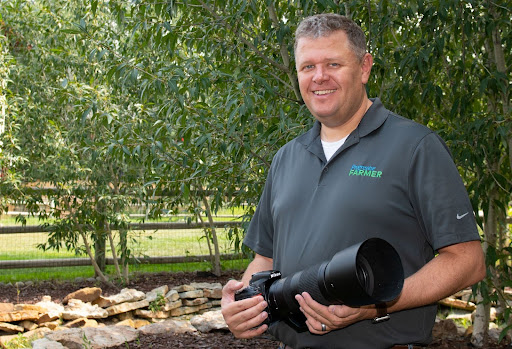
By Joel Reichenberger, ACN President
I hadn’t been on the farm for five minutes when I was caught completely off guard.
The farmer I was there to see, who I was set to spend the next 24 to 36 hours photographing, asked me a question I’d never come across before.
“What photos did ChatGPT tell you to take of me?” he said after we shook hands in his office.
Uh……,” I thought.
“Uh……,” I said.
AI is everywhere, but I’ve not met anyone yet using it as aggressively as this farmer.
He seemed to use it for everything.
Asking AI for advice on photography had not crossed my mind, and after sputtering, I said as much.
“Oh,” he said, taking on my role as the dumbfounded one.
I suspect I’m somewhere in the majority of ACN members here when I say I find the use of generative AI somewhat uncomfortable, but that I’m trying to find ways to use it in my work anyway.
And I have found a few.
Taking advice from a reporter friend, I have on several occasions used AI at industry press conferences where there’s a big announcement, and I can expect some one-on-one or small group interviews afterward. I’ll run the speech through a transcription service, plug that text into AI, and ask for good questions about points the speaker may have talked around or missed.
Our beats can be so wide these days. I cover machinery and technology, everything from internet speeds to ATVs, large tractor autonomy to import difficulties.
I can’t be an expert on all of it. (Am I an expert on any of it? Let’s not tug at that thread.) So asking an AI agent to help me read between the lines in some CEO’s speech on a topic I’m only marginally read up on seems like a good use, and the results have proven worth my while.
Using base-level free AI, about two of every 10 questions are clever and insightful, something I may not have noticed and that I definitely want to ask about. Another four of the 10 are good questions that were already on my radar. And the final four tend to miss the mark.
Other times, I’ve had AI crawl through interview transcripts to find the best applicable quotes for a certain section of a story. That’s mostly worked, and double-checking the supplied quotes has proven them to be accurate and in context.
And still, I didn’t ask AI about a farmer before I met him.
So, I asked it after I met him.
In the interest of exploration, I forked over $20 for a month to access a higher-level model (the farmer insisted I needed to do better than the free option) and asked for suggestions on how to photograph my subject.
The results, as with many things in AI, were a mix of impressive and unsettling.
It picked up on the fact that my farmer was more manager than combine driver, and his story would be better told by photos in the office or overseeing operations than actually wrenching on the combine. (That’s fine, but not super photogenic. For better or worse, the combine was broken the next morning, and he logged several thoroughly photographed hours wrenching on it.)
On the unsettlingly-good side of things, the farmer had served 12 years in the military, but after I asked about it, he made a point to tell me he wasn’t interested in working it into the photography in any way.
AI both picked up on the fact that he’d served and was tuned in enough to warn me off of trying to shoehorn his service into any particular photo, suggesting it’d seem out of place and contrived, basically exactly the conversation we’d just had.
Much of what AI offered was already on my list or became apparent after a few hours on the farm. Some of the suggestions, elaborate beyond reason, I ignored and some I took to heart.
My post-shoot verdict? It wasn’t life-changing advice, but I’ll probably ask AI before I visit the next farmer.
We’re at a point in the ACN calendar where we’re really trying to dial in what we want to accomplish in the next year, what our priorities should be. Please send your ideas and suggestions, but for me, nothing seems as important for this organization to get its arms around as artificial intelligence.
We’ve had speakers on AI topics at most of our recent seminars and events, and I expect we will going forward, too. We all have a lot to learn, and we can all stand to take lessons from each other’s wins and losses. And, we as an organization need to iron out clear recommended ethics policies because right now there looks to be a whole lot of gray area.
It still makes me feel weird sometimes. I, for instance, even though it’d fit the theme of what I’m talking about, I didn’t run this column through AI because I’m not sure how my fragile ego would handle the computer spitting back a much-improved version. (Would I have to quit journalism in shame? I’m sorry, AI, I have a mortgage.)
There’s a world between “never going to touch it,” and “it’s writing all of our articles” and feeling uncomfortable about it isn’t an acceptable response anymore. I’m not sure we can be successful in the communication business if we don’t search for the right limits between those points, both individually and as an organization.
In time, AI will be as common a tool as Microsoft and Adobe products, and it’ll probably be more important. We need to be ready for that, even if for now the concepts sometimes leave us stuttering five minutes after arriving at the farm.
-Reichenberger is senior editor at Progressive Farmer.